
The Book That Started Everything — And It Was Not a Business Book

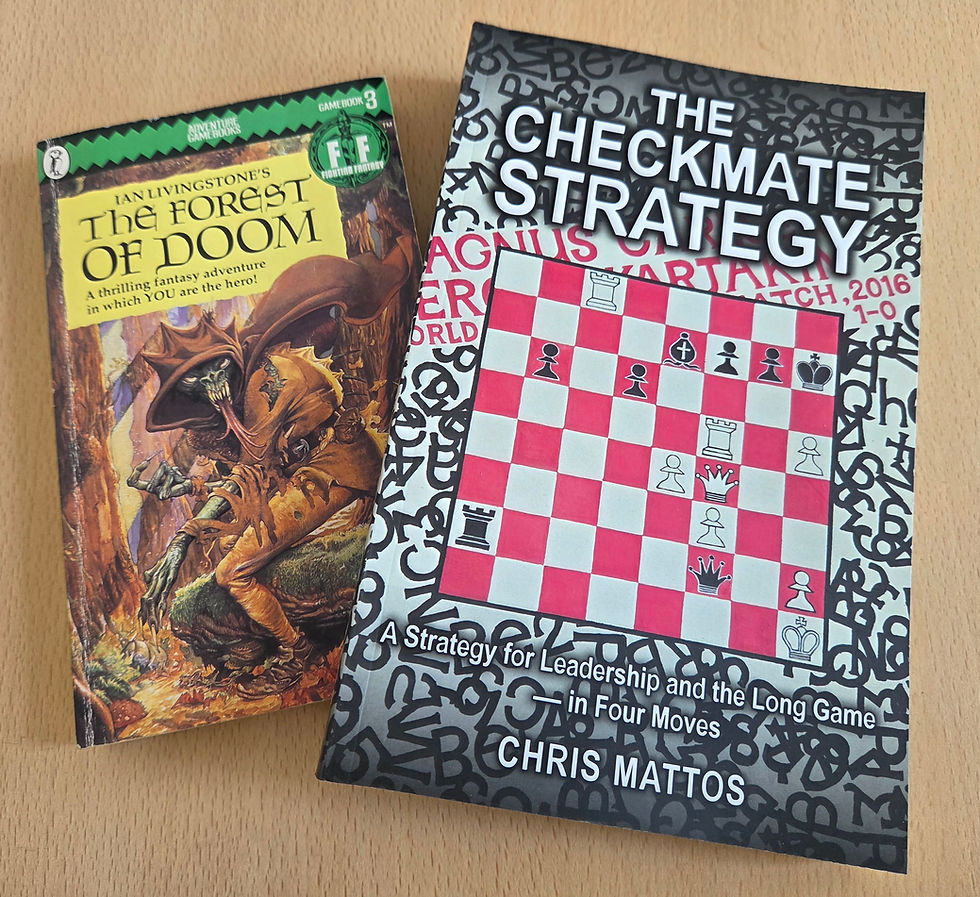
Part I of The Checkmate Strategy traces twenty books that shaped the way I think. This is the first.
In 1986, a book arrived in my hands that had nothing to do with strategy, leadership or professional judgment.
It was a Fighting Fantasy gamebook. Forest of Doom by Ian Livingstone. You played the hero. You made the decisions. You rolled dice to determine the outcomes. And if you made the wrong choice—chose the wrong door, fought the wrong creature, trusted the wrong stranger—you died and started again.
I had no idea I was learning anything.
What the book actually taught
Forest of Doom was the beginning of a series. Over the years that followed I worked my way through many of them—City of Thieves, House of Hell, Seas of Blood, Trial of Champions—and each one required something slightly different.
City of Thieves rewarded patience and social intelligence. You could talk your way past some obstacles that fighting would have made worse. House of Hell rewarded restraint—the instinct to avoid rather than confront. Seas of Blood introduced moral complexity and resource management. Trial of Champions stripped everything back to its essentials—a single unforgiving sequence where a wrong choice ended the adventure immediately and the only path through was clear thinking applied correctly the first time.
What I was learning—without knowing I was learning it—was that different situations require different methods. That the approach which works in one context fails in another. That reading the situation correctly before acting on it is not a luxury—it is the discipline on which everything else depends.
Why this matters for the work you are doing now
Most professional cultures reward a default method. The way things are done here. The approach that has always worked. The response that feels safe because it has precedent.
The problem is that situations change. The position in front of you now is not the same as the position that established the default. And applying a familiar method to an unfamiliar situation—without pausing to ask whether it fits—means working hard without getting anywhere useful. Effort that has to be repeated rather than built upon.
This is what The Mind addresses in The Checkmate Strategy. Clarity before commitment. Understanding the position you are actually in before deciding what kind of response it requires.
It is also what Chess for Tigers—Book 3 in the twenty—would later make explicit: win the game you are in, not the game that would impress onlookers. Play your game. Not the profession's default one.
But Forest of Doom got there first. With a six-sided dice and a pencil.
The question worth sitting with
Think about the most significant challenge you are currently facing at work.
Now ask: am I responding to this situation as it actually is—or am I applying a method that worked somewhere else, at a different time, under different conditions?
If the answer is the latter, the first step is not to work harder. It is to pause long enough to read the position correctly before you commit to a move.
That is The Mind. And a Fighting Fantasy book taught it to me before I had words for it.
The Checkmate Strategy is available on Amazon. If you are finding these posts useful, subscribe below to receive one each week—drawn from the twenty books and forty-two lessons that shaped the framework.
Next week: Think Like a Grandmaster—and what a Soviet chess manual taught me about the difference between analysis and decision.


Comments